Blog Archives
The Evolution of AI: From ANI to AGI and Beyond
AI
Artificial Intelligence (AI) has been a topic of fascination, hope, and concern for decades. As we progress in this field, it’s crucial to understand the different types of AI and their potential implications for our future. In this post, we’ll explore Artificial Narrow Intelligence (ANI), Artificial General Intelligence (AGI), and Artificial Superintelligence (ASI), including predictions about when each might be achieved.
Artificial Narrow Intelligence (ANI)
Artificial Narrow Intelligence, also known as Weak AI, refers to AI systems designed and trained for a specific task. ANI is what we currently have and use in our daily lives.
Examples:
- Virtual assistants like Siri or Alexa
- Recommendation systems on platforms like Netflix or Amazon
- Image recognition software
Current Status: ANI is already here and continually improving.
Artificial General Intelligence (AGI)
Artificial General Intelligence, or Strong AI, refers to a hypothetical AI that can understand, learn, and apply its intelligence to solve any problem, much like a human can.
Characteristics:
- Ability to reason, plan, solve problems, think abstractly
- Learn and adapt to new situations without specific training
Predictions: Estimates for when we might achieve AGI vary widely:
- Ray Kurzweil, futurist and Google engineer, predicts AGI by 2029 [1].
- A survey of AI experts at the 2022 Conference on AI Safety predicted a 50% chance of AGI by 2061 [2].
- Some experts, like Rodney Brooks, believe AGI is much further away, possibly centuries [3].
Artificial Superintelligence (ASI)
Artificial Superintelligence refers to an AI system that surpasses human intelligence and capabilities in virtually every field.
Characteristics:
- Far superior problem-solving and creative abilities compared to humans
- Potential for exponential self-improvement
Predictions: Estimates for ASI are even more speculative than those for AGI:
- Nick Bostrom suggests that if AGI is achieved, ASI could follow within days or years [4].
- Ray Kurzweil predicts the singularity (which could lead to ASI) by 2045 [1].
- Sam Altman (CEO of Open.ai) says “in a few thousand days”!
- Many experts argue that predicting ASI is premature without first achieving AGI.
Conclusion
The journey from ANI to AGI and potentially to ASI represents a profound transformation in artificial intelligence. While ANI is already a part of our daily lives, the timelines for AGI and ASI remain highly uncertain and debated. As we continue to advance in AI research and development, it’s crucial to consider both the potential benefits and risks associated with these powerful technologies.
Remember, predictions in this field are notoriously difficult, and many experts caution against overconfidence in specific timelines. The development of AGI and ASI, if they occur, will likely be gradual processes rather than sudden breakthroughs.
Sources:
[1] Kurzweil, R. (2005). The Singularity is Near: When Humans Transcend Biology. Viking.
[2] Zhang, B., Anderljung, M., Kahn, L., Dreksler, N., Horowitz, M., & Dafoe, A. (2022). Ethics and governance of artificial intelligence: Evidence from a survey of machine learning researchers. Journal of Artificial Intelligence Research, 71, 591-666.
[3] Brooks, R. (2017, September 7). The Seven Deadly Sins of AI Predictions. MIT Technology Review.
[4] Bostrom, N. (2014). Superintelligence: Paths, Dangers, Strategies. Oxford University Press.
Share this:

Favorite Things – NEST Thermostats
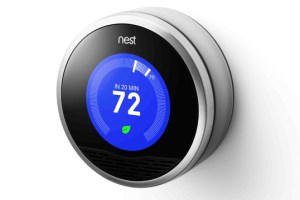 The Nest Learning Thermostat automatically adapts as your life and the seasons change. Just use it for a week and it programs itself.
If NEST learns that I wake up every morning at 5:30 and immediately hit the thermostat to raise the temp by 5 degrees, then NEST will begin AUTOMATICALLY having the temp adjusted so that it is the temperature that I desire at 5:30 am.
As NEST learns that the house is empty by 8 a.m. each day, it will automatically adjust itself so as to not run while no one is home. Sure, I can program in a schedule, but why? I let NEST learn our patterns and schedule itself to be the most energy efficient possible.
Let’s say I am leaving work on a cold cold day. Before leaving, I can use my smartphone and tell NEST to have the house at 75 degrees before I get home. It’ll do it!
Or why should I even have to tell it. I can program NEST to automatically adjust to my desired temperature whenever my car leaves my office. It knows I am on my way home, so let’s get the house comfortable.
NEST can also communicate with my other home automation systems. NEST senses when no one is home, so I can have all my lights automatically turn off when NEST senses no one is there.
If I tell my Amazon Echo that “Alexa, I’m Hot”, it will automatically lower NEST by 5 degrees. Or “Alexa, I’m Cold” will automatically raise the temp by 5 degrees.
The Nest Thermostat is just one part of my heating and cooling system. But it can keep an eye on the rest of it. I get an alert on my phone if there’s something wrong – like temperatures are so low my pipes could burst. And if it looks like my furnace is acting up, the Nest Thermostat will send me an alert.
Nest shows you how much energy you use every day in Energy History and every month in your Home Report. So you can see when you use more energy, like on weekends or Monday nights, and how to use less.
NEST not only saves me money by programming itself to be the most energy efficient possible, but it also makes my life more comfortable.
Share this:

Favorite Things – Schlage Door Lock
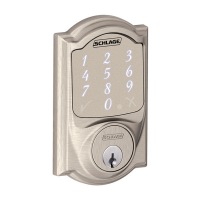 As I continue my quest to fully automate my home, one of my favorite things is my Schlage Door Lock. This door lock connects to my other home automation devices and works in conjunction.
For example, when my car pulls into the driveway, In addition to my lights coming on, the back door will also automatically unlock for me. This is great when you have your hands full with groceries or work stuff.
Whenever anyone leaves the house, the door will automatically lock itself.
In addition to working automatically or by a key, it also has a digital keypad. This allows me to program in a combination so that if I don’t have my house keys with me, I can still get inside my house. Vonnie loves to lock a door. So often, I’ll step outside and when I return, the door is dead bolted. Now, I can simply enter the combination and get inside without having a key.
If the exterminator calls me and tells me he is standing outside my house and needing to get in to spray, I can simply unlock my door from my smartphone from anywhere in the world. After he leaves, the door will lock back automatically.
Or maybe I have a friend or family member that I know is stopping by at some point this week to pick up something that I am loaning them. I can give them a temporary passcode that will allow them to enter – but the code will only work for this week.
Ever head off on vacation, get 50 miles from home and then suddenly worry, “Did I lock the door?”. No worry now, as I can simply log in and check the lock condition or just click a button to make sure it is locked. Really cool!
Share this:

Favorite Things – Phillips Hue
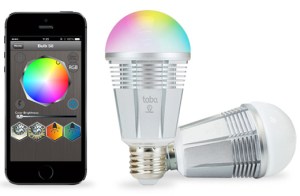 My family is constantly rolling their eyes at me. Yeah, I like technical toys. Phillips Hue Lighting System is a wonderful technical toy. Basically you replace any light bulbs in your house that you wish with these energy efficient LED bulbs. The lights can then be controlled by your smart phone or by very simple programming through IFTTT (google that if you don’t know what it is).
So, what’s the advantage? I have my lights programmed at the house for the following:
Whenever my car pulls up into the driveway, the outside backdoor patio lights automatically turn on to light my way. Also the indoor dining room light turns on as well. As I walk into the house, all the lights will quickly go through a complete rainbow pattern to simply celebrate the fact that I am home. (This produces the biggest eye-rolling from my family).
At 2:00 am. each morning, all lights in the house automatically go off (in case we left any turned on).
At whatever time each morning I need to get up, my bedroom lamp will softly begin illuminating brighter and brighter. Calm. It’s like waking up with the sunrise. And the color of the light is a soft orange (sunrise) color as well.
As I step out of my bedroom into the hall, I notice my hall light. If it is BLUE then I can expect rain that day. If it is orange, I can expect it to be hotter than normal.
Whenever my Ga. Tech Yellow Jackets win an event, all the lights in the house will flash and then go through a rainbow pattern in celebration.
When it’s movie time, the lights are lowered for a more theatre like effect.
Whenever I leave the house, after I exit the property, the back door patio lights will turn off.
If we are away on a trip, I can program the lights via a schedule or a random pattern to turn on and off to give the illusion that someone is home. Or I can just control individual lights from my Iphone at any time from anywhere.
If I am REALLY in the party mood, I can even have the lights sync with the music I am playing on my Amazon Echo and the lights will dance with the music.
Since each individual light is fully programmable with millions of color combinations, I can set the mood that I want. From a soft blue or soft red for romantic climates to a soft white in order to read a book. Maybe a little brighter if I am writing in a journal.
I love my toys. Phillips Hue is one of the best!



 Shelly Berryhill